Your Ideas Matter
Jayhawks Elevate is successful because of you. Your ideas make us better. Read some of the stories of our successes so far to improve your campus experience. Maybe you will be next!
Financial Literacy Resources and Training Expansion
When Addison and Angie submitted an Elevate idea, they noted that KU staff and faculty would benefit from clearer financial literacy resources, guidance, and training opportunities related to KU financial processes and budgeting practices. Financial information and procedures were often difficult to navigate, especially for new employees or individuals without a finance background.
In response, the Financial Shared Service Center and campus partners expanded financial literacy resources and training opportunities across the university. The initiative introduced knowledge base guides, training materials, lunch and learns, budgeting sessions, and new employee education to help faculty and staff better understand KU financial systems and processes.
Resources are now available through New Employee Orientation, the Finance Service Portal Knowledge Base, campus communications, and direct support from finance staff. Additional efforts are underway to develop short instructional videos and further improve resource accessibility.
The project continues as an ongoing initiative focused on improving understanding of financial processes, reducing confusion, and increasing access to financial education resources across campus.
Fellow Change Agents:
- Addison Keegan Harris
- Angie Loving
- Cindy Jacobson
- Missy Somers
- Tanner Grubbs
- Alina Edmondson
- Jessica Chilcoat
- Chris Bell
- Amy Carlson
- JMC 645 Media Arts Capstone Students (Spring 2026)
Impact of idea:
- Expanded access to financial literacy, budgeting resources, and finance support tools across campus
- Reduced confusion around financial processes while improving onboarding and training opportunities for employees
- Enhanced accessibility of financial guidance materials and encouraged more proactive financial planning and budgeting discussions

AI Training and Support for Finding Efficiencies
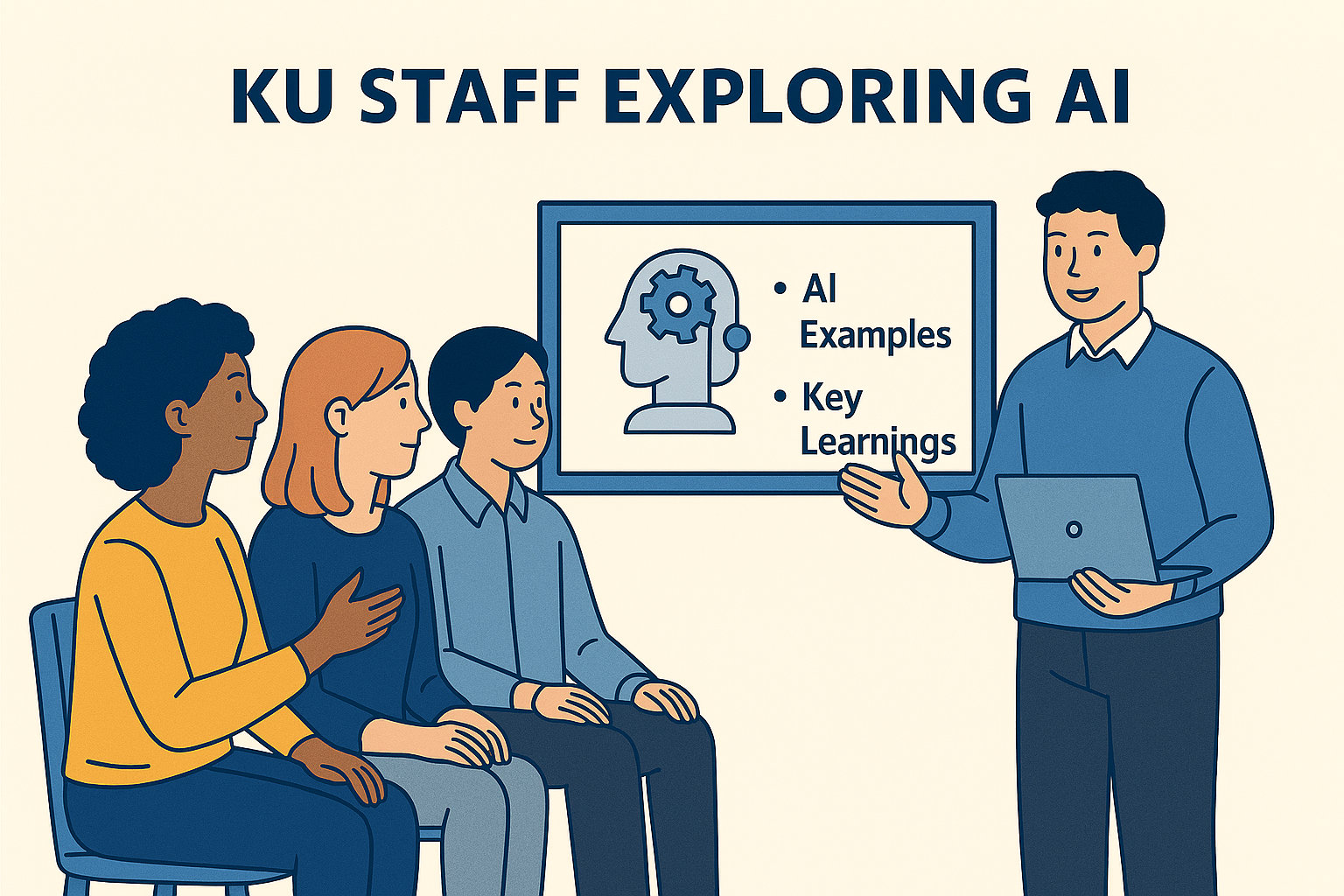
As interest in using Copilot AI grew, Kristine Latta and Amanda Temple recognized a gap in training and hands-on support needed to help staff effectively apply AI to everyday administrative work at KU. While faculty had begun organizing resources and workgroups focused on AI in research, teaching, and learning, staff lacked a consistent forum to share practical use cases, ask questions, and receive peer support.
To address this need, a small group launched Automate & Elevate, a staff-focused community modeled after the faculty workgroup. The community meets twice monthly and emphasizes practical applications through real-world examples, live demonstrations, and peer learning rather than formal training alone. Session recordings and materials are shared in Teams, allowing participants to revisit content and continue learning over time.
This approach provides a flexible, low-barrier environment where staff can bring real challenges, learn from colleagues actively using AI, and build confidence incrementally. In addition, the community helps identify common needs and themes that can inform future, more targeted IT or campus-wide training efforts.
Fellow Change Agents:
- Kristine Latta
- Amanda Temple
- Tanner Grubbs
- Matthew Lawrence
- Jason Koepp
- Craig Alexander
Impact of idea:
Automate & Elevate provides KU staff with practical, relatable examples of how AI can be applied to daily work in a supportive, collaborative setting. By creating a safe space to ask questions and solve real problems together, the community encourages broader adoption of AI tools. The primary benefit to KU is a more engaged and connected staff who are increasingly equipped to leverage AI
Simplifying Parking and Delivery Navigation on Campus
When Teresa joined KU in January, she noticed how confusing parking rules and delivery logistics were for staff and outside vendors. From permits to loading zones, information was hard to find, and delivery drivers often wandered buildings unsure where to go—sometimes ending up with $50 tickets.
Teresa submitted an Elevate idea calling for clearer guides and directions. In response, KU Parking updated the Where to Park section of their website with a new Delivery Parking page. This single resource provides straightforward instructions for staff and drivers, making it much easier to get in and out of campus quickly.
Now, staff no longer need to create custom directions for every vendor, and drivers avoid confusion and costly tickets. The change has streamlined deliveries and improved the overall campus experience.
Fellow Change Agents:
- Teresa Fry
- Aaron Quisenberry
Impact of idea:
- Faster, more reliable deliveries
- Reduced staff time spent guiding vendors
- Fewer tickets and frustrations for delivery drivers

One KU Onboarding Resource Guide
As Addison’s office transitioned into a One KU office, she and her team began experiencing the challenges of working across both KU Lawrence (KUL) and KU Medical Center (KUMC). Navigating badge access, parking, IT systems, and even scheduling meetings quickly revealed that resources were scattered, inconsistent, or in some cases, missing altogether. Addison recognized that without a consolidated guide, One KU teams would continue to struggle with duplicative effort and confusion.
In response, a collaborative group of HR, IT, and administrative staff from both campuses came together to design a single resource that would clarify what employees need to know when working between Lawrence and KUMC. Over a series of meetings, the team aligned information on badge access, parking privileges, IT systems, email and collaboration, HR/payroll processes, campus safety, tours, and room reservations. The resulting One KU Orientation & Resource Reference highlights where processes align and where campus-specific differences remain, helping employees know exactly where to start, what to request, and who to contact.
The resource is now live on both campuses: posted on the KU Lawrence HR Onboarding site and Affiliate site, and on the KUMC HR Onboarding site. Jody Milford and Paul Mintner confirmed ownership of updates for their respective campuses, ensuring the resource will remain current as systems evolve.
Fellow Change Agents:
- Addison Keegan-Harris
- Jody Milford
- Paul Mintner
- Nick Galindo
- Luke Mancillas
- Regina Casto
- Brittany Sanchez
- Tom Johnson
Impact of idea:
This project reduces confusion and delays for employees working across both campuses by providing a single, authoritative reference. Instead of piecemeal emails or word-of-mouth guidance, staff now have real-time access to clear instructions, saving significant time for employees and HR staff while improving onboarding consistency and overall employee experience.

Required Training for Financial System Access
Melissa Stewart and Dana Goble noticed that new hires often struggled with financial systems because there wasn’t a consistent training process in place. Each supervisor handled training differently, which led to confusion, mistakes, and extra work for the Help Desk. A lot of the questions we were getting could have been answered in training if everyone had gone through the same program.
To fix this, the team decided to create a streamlined training program for new hires. The training is tailored to their job roles and is now offered every week instead of every two weeks. An email with quick tips and training resources is sent out to new users to make sure they know about the resources and encourage them to attend training sessions. We’re also working on refresher training to address system updates and common issues.
So far, the changes have made a big difference. New users are more prepared, the number of questions coming to the Help Desk has gone down, and 5 out of 6 new users have attended training. It’s been a great step toward making the system easier for everyone to use.
Fellow Change Agents:
- Hunter Rabe
- Nolan Haire
- Dawn Kilburn
- Melissa Stewart
- Colette Gillespie
- Caitlin Wedel
- Ramia Whitecotton
Impact of idea:
These changes will enhance the user experience, reducing the need for Help Desk interventions and saving valuable time and resources in the long run.