Your Ideas Matter
Jayhawks Elevate is successful because of you. Your ideas make us better. Below are some examples of processes being improved by your peer's ideas. Check out changes being made. Perhaps you have an idea to submit too!
Standardized IT Purchasing Program
As computer costs continued rising across higher education, Procurement and IT teams at the University of Kansas and Kansas State University saw an opportunity to work differently. Departments were purchasing a wide variety of laptops and desktops independently, which increased costs and made technology support more complex.
Through collaboration supported by Jayhawks Elevate, KU and K-State partnered to create a shared purchasing strategy focused on cost savings, efficiency, and long-term pricing stability. The teams reviewed purchasing trends and common technology needs across both campuses, then developed a shared catalog of standardized Windows PC configurations that would meet most institutional needs while still allowing flexibility for specialized requests.
By combining purchasing demand and negotiating together, KU and K-State significantly improved supplier pricing on Dell devices. Together, the institutions increased discounts from approximately 19% off list pricing to an average of 61% off list pricing this quarter. The agreement also includes a 2% annual rebate on eligible Dell purchases, creating additional long-term value for future technology investments.
The partnership also helped protect both universities from projected increases in Windows PC costs driven by AI-related component inflation. Beyond the financial savings, standardized devices allow IT teams to streamline deployments, simplify troubleshooting, and provide more consistent support experiences for faculty and staff.
This collaboration highlights how cross-institutional partnership and thoughtful standardization can create meaningful operational and financial benefits for higher education institutions.
Fellow Change Agents:
- Ben Lizak
- Craig Alexander
- Ephrom Marks
- Nick Galindo
- Louis Antoine Sr.
- John Rinnert
- Rebecca Gould (K-State)
- Gregory Flax (K-State)
- Jim Barnes (K-State)
- Memory Buffington (K-State)
- Garrett Truskett (K-State)
Impact of idea:
- Improved negotiated pricing on Dell devices from approximately 19% off list pricing to an average of 61% off list pricing
- Established a 2% annual rebate opportunity on eligible Dell purchases
- Created pricing protection during a period of projected 35–45% Windows PC cost inflation
- Reduced IT support complexity through standardized computer configurations
- Faster device deployment and more consistent troubleshooting processes
- Improved operational efficiency and long-term technology sustainability across participating institutions
- New agreement allows smaller KBOR schools to leverage KU/K-State discounts

Streamlining Employee Tuition Assistance Processing and Timing
An employee at KU received approval for tuition assistance but was still billed several thousand dollars in Enroll & Pay. After reaching out, they were told everything was fine and the waiver would be applied later. While the issue eventually resolved, the experience created unnecessary stress and raised a broader concern around how well systems were aligned.
As more examples surfaced, it became clear this was not an isolated issue. Delays between HR approval and application in Enroll & Pay led to confusion, increased inquiries, and extra manual work across teams.
The team partnered with HR, Student Accounts & Receivables, and IT to understand where the breakdown was occurring. The issue stemmed from timing gaps, manual steps, and limited visibility into where requests were in the process.
To address this, the workflow was restructured into a centralized, queue-based process with clearer routing and tracking. Replacement and cancellation functionality was introduced to ensure only the most accurate request moves forward. Form visibility was improved for processing teams, and file transfer steps to Student Accounts were refined to support more timely application.
The result is a more coordinated and transparent process that reduces confusion for employees and improves consistency across teams.
Fellow Change Agents:
- Julie Popiel
- Regina Casto
- Monica Shafii
- Mandy Tucker
- Justin Carroll
- Kay Walden
- Jody Milford
- Kevin Kenn
- Mary Ann Richey
- Cheryl Harber
Impact of idea:
- Reduced follow-ups and employee confusion - Fewer employees are reaching out to HR and Student Accounts to confirm their benefit, reducing back-and-forth communication and allowing teams to focus on processing rather than responding to inquiries.
- Faster and more reliable application of benefits - Improved workflow and file transfer timing help ensure tuition assistance is applied closer to when it is approved, reducing delays and minimizing the risk of large, unexpected balances appearing on student accounts.
- Less manual rework and process intervention - Clear routing, tracking, and replacement functionality reduce the need to manually correct or stop outdated requests, saving time for processing teams and improving overall accuracy.

Improving Outside Scholarship Posting Process
A student received an outside scholarship and expected to see it reflected on their account. Instead, the funds were delayed, applied incorrectly, or in some cases duplicated. When errors surfaced, staff had to step in to manually fix records, and occasionally students were asked to return funds they were never meant to receive.
As more situations like this came up, it became clear the issue was not isolated. The outside scholarship process relied heavily on a shared spreadsheet, multiple handoffs between Financial Aid and Student Accounts & Receivables, and repeated manual data entry. This led to common issues such as incorrect IDs, duplicate postings, wrong term splits, and delays when checks sat unprocessed or donors resent funds.
The team partnered across Financial Aid, Student Accounts & Receivables, and IT to understand where the breakdown was occurring. Key gaps included inconsistent student-reported information, limited visibility across teams, and a process that required the same data to be interpreted and re-entered multiple times.
To address this, the process was redesigned to better align with how financial aid is managed. Ownership of outside scholarship posting shifted to Financial Aid, allowing the team closest to the award to manage it end-to-end. A group-post file approach is being implemented so scholarships can be prepared and uploaded in batches, reducing handoffs and eliminating duplicate data entry.
The result is a more streamlined and reliable process that reduces errors, shortens processing time, and improves coordination across teams while creating a better experience for students.
Fellow Change Agents:
- Mary Frances Riner
- Mandy Tucker
- Olivia Vaca
- Stephanie Covington
- Jasmine Moore
- Dee Anna Rendall
- Angie Dopp
- Bria Cruse
- Amanda Cushing
- Ester Cha Juarez
Impact of idea:
Eliminating duplicate data entry and reducing handoffs between teams decreases the likelihood of incorrect IDs, duplicate postings, and misapplied funds, saving time spent identifying and correcting errors.

Further Refinement of IT Software Approval Process
Cameron Piercy and David Hansen voiced their concerns with the software approval process. When these issues were brought to the IT and Procurement team, then also realized there was some ongoing frustration across campus with the software approvals process, particularly around repeat reviews and uncertainty about what software was already approved. Faculty and staff were often asked to complete full approval workflows even when tools were widely used or previously vetted.
To address this, KU IT, Procurement, and Financial Services worked together to simplify and clarify the process. One key outcome was confirming that software listed on the IT website (technology.ku.edu) is already considered IT-supported and approved. For other software, the teams aligned on a streamlined approach that allows designated staff in IT and Procurement to approve routine or previously reviewed requests directly, rather than sending everything through a full review.
As a result, software requests now move faster, expectations are clearer, and there is less confusion about when an approval is actually needed. The updated process maintains security and compliance while reducing unnecessary handoffs and improving the experience for faculty and staff.
Fellow Change Agents:
- Cameron Piercy
- Dave Hansen
- Ed Hudson
- Ben Lizak
- John Rinnert
- Esmeralda Phillips
- Luke Raynor
- Erin Sommer
- Aimee Losey
Impact of idea:
- Reduced approval time and fewer handoffs for common software requests, improving turnaround and reducing administrative effort across campus.
- Streamlining routine software approvals could reduce administrative effort by approximately $5,850 per year

Simplifying University Sponsorship Submission
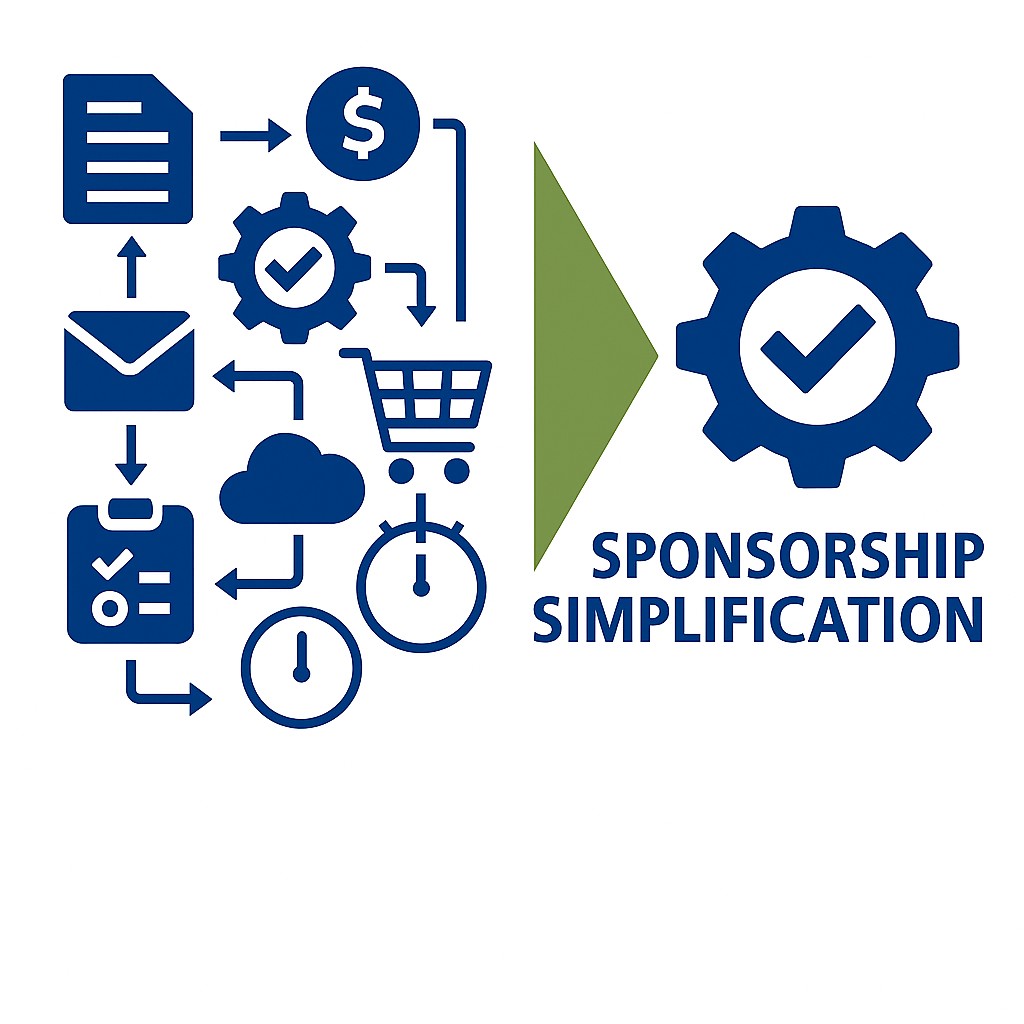
The sponsorship process had grown into two forms, a 3G sponsorship form and a regular sponsorship form. Even though both were accomplishing the same core objective, they created duplication, confusion, and extra coordination. Submitters and processors had to decide which form to use, the team had to maintain two sets of instructions and logic, and the intake and routing steps were not as consistent as they needed to be. Over time, this created avoidable rework, follow-ups, and inconsistent handling depending on which path a request entered through.
To fix this, the team partnered with KU IT Perceptive content team to redesign the sponsorship intake into one consolidated form that covers both 3G and regular sponsorship needs. Alongside the form build, we aligned and updated the downstream process so sponsorship submissions route cleanly through the right Perceptive Content queues/workflow rather than being managed differently based on which form started the request.
The end result is a sponsorship process that is easier to use, easier to maintain, and more consistent for processing teams. Instead of two separate entry points, the campus now has a single standardized intake that supports the full range of sponsorship scenarios and routes them through a clearer queue-based workflow.
Fellow Change Agents:
- Kara McDowell
- Mandy Tucker
- Chris Bell
- Beth Benfield
- Morgan Swartzlander
- Cheryl Harbor
Impact of idea:
- One consolidated form collects the right info the first time, so the team spends less time chasing missing details, correcting misrouted requests, or asking submitters to redo things.
- Standardized queue routing means requests move through the same workflow every time, making processing smoother, reducing pings, and lowering the chance something stalls because it entered through the wrong path.